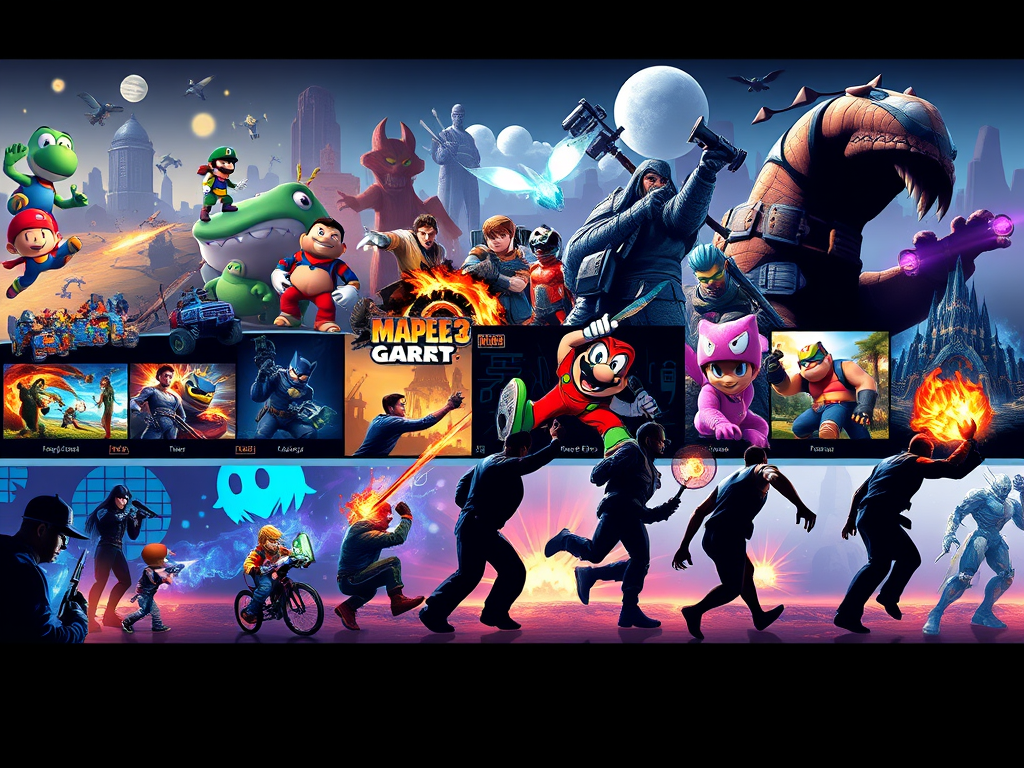
The video game industry has undergone an extraordinary transformation over the past few decades. What started as simple pixelated graphics on bulky arcade machines has now evolved into expansive, photorealistic worlds, playable through powerful consoles and immersive virtual reality systems. The journey from 8-bit graphics to photorealism in video games reflects not only technological advancements but also changing cultural perceptions of gaming as an art form.
The Birth of Video Games
The history of video games begins in the 1950s, but it wasn’t until the 1970s that they became a mainstream pastime. Early games like Pong (1972) were simple, two-dimensional games featuring basic black-and-white graphics. These early games were limited by the technology available at the time but laid the foundation for an industry that would grow into one of the most profitable forms of entertainment worldwide.
The Early Days: 8-Bit Graphics
The 1980s marked the dawn of home gaming consoles and the rise of arcade gaming. Iconic games like Super Mario Bros. (1985) and Pac-Man (1980) were among the first to showcase 8-bit graphics, a standard that dominated the early era of video games. These graphics were composed of pixelated blocks and simple color schemes that created the blocky but charming characters and worlds players grew to love.
The limited resolution and processing power of these systems restricted developers’ ability to create intricate, realistic environments. Yet, despite these limitations, the creativity of developers shone through. Games focused on tight, engaging gameplay mechanics, offering addictive experiences that kept players returning to arcades or their home consoles for more.
The 16-Bit Era: Pushing Boundaries
By the early 1990s, the gaming industry had begun to embrace 16-bit graphics. The introduction of consoles like the Sega Genesis (1989) and Super Nintendo Entertainment System (SNES) allowed developers to craft more detailed and colorful games. Sonic the Hedgehog (1991) and The Legend of Zelda: A Link to the Past (1991) were two prime examples of how 16-bit technology enhanced the visual experience, offering more vibrant colors, smoother animation, and larger game worlds.
While the technological leap was significant, games from this era still maintained a relatively blocky aesthetic. However, this was the period that saw the first truly immersive 2D games, including side-scrolling platformers and top-down adventure games, where the visuals were designed to complement the narrative and gameplay. The 16-bit era was a stepping stone toward the next leap: the transition from 2D to 3D environments.
The 3D Revolution: The 32-Bit and 64-Bit Eras
The mid-1990s brought about a technological revolution in gaming: the shift from 2D to 3D graphics. With the arrival of consoles like the Sony PlayStation (1994) and the Nintendo 64 (1996), developers gained the ability to create fully three-dimensional worlds. Super Mario 64 (1996) and Final Fantasy VII (1997) were landmark games that embraced this new dimension, allowing players to explore vast, open worlds with freedom and depth.
Polygonal Graphics and the Challenge of 3D Worlds
Although 3D graphics opened up a whole new world for developers, creating them came with a set of unique challenges. Early 3D games often featured polygonal characters and environments that looked jagged and rough by today’s standards. Games like Tomb Raider (1996) and The Legend of Zelda: Ocarina of Time (1998) were groundbreaking for their time, introducing dynamic camera systems, vast 3D environments, and complex storytelling, all within an era where graphical fidelity was still in its infancy.
Nevertheless, the 3D revolution sparked an entire generation of new game genres, from 3D platformers to first-person shooters. Despite the limitations, these games showcased the potential of 3D space and proved that gaming had entered an exciting new chapter.
The HD Era: Expanding Realism
As the new millennium approached, the gaming industry began moving toward high-definition (HD) graphics. The release of the Xbox 360 (2005) and PlayStation 3 (2006) brought with it the ability to render games in true 720p and 1080p resolution, pushing graphics to a new level of realism. Alongside improved resolutions, developers began incorporating more advanced techniques, such as anti-aliasing and motion blur, to smooth out jagged edges and create more natural movement.
A New Era of Photorealism
The HD era was defined by a significant leap toward photorealistic graphics. Titles like Grand Theft Auto IV (2008) and Uncharted 2: Among Thieves (2009) used these new graphical advancements to create highly detailed, lifelike characters and environments. Developers began pushing the boundaries of what was possible, incorporating realistic lighting, textures, and physics to create more believable worlds. The sheer attention to detail in these games made the virtual worlds feel like real places, bridging the gap between fantasy and reality.
The Rise of Next-Gen Graphics: 4K and Ray Tracing
In the 2020s, the gaming world saw another leap forward with the release of next-gen consoles like the PlayStation 5 (2020) and Xbox Series X (2020). These consoles brought 4K gaming to the forefront, enabling players to experience stunningly detailed visuals at resolutions far beyond previous generations.
Ray tracing, a rendering technique that simulates how light interacts with objects in a scene, became a hallmark of next-gen graphics. This technology enhances visual fidelity by creating realistic reflections, shadows, and lighting effects. Games like Cyberpunk 2077 (2020) and Control (2019) showcased ray tracing’s power, delivering jaw-dropping visuals that brought virtual worlds to life like never before.
Hyper-Realistic Graphics and the Quest for Realism
As technology continues to evolve, the pursuit of photorealism in gaming remains at the forefront. We’re now seeing games with textures so detailed and lighting so realistic that they’re often indistinguishable from real-life footage. With the continued development of graphics cards, like Nvidia’s RTX series, and the introduction of technologies such as DLSS (Deep Learning Super Sampling), developers are able to render these hyper-realistic visuals in real-time without sacrificing performance.
In addition to ray tracing, advancements in AI-driven animation, motion capture, and physics simulations are helping create even more lifelike characters and environments. Game developers are using cutting-edge technology, like facial recognition and body motion capture, to create characters whose movements and expressions closely mimic real-world actors.
The Future of Video Game Graphics
As we look to the future, the next big leap in gaming graphics could involve the advent of virtual reality (VR) and augmented reality (AR) technologies. These immersive technologies promise to transport players into fully realized 3D worlds, allowing for unprecedented levels of interaction and immersion. VR headsets like the Oculus Rift and PlayStation VR already offer a glimpse into this future, and as technology continues to improve, we may soon find ourselves playing games that feel indistinguishable from reality.
Moreover, cloud gaming services like Google Stadia and Xbox Cloud Gaming are pushing graphics to new heights without the need for powerful local hardware. By streaming games from high-end servers, players will be able to experience photorealistic graphics regardless of their hardware setup.
Conclusion
From 8-bit graphics to photorealism, the evolution of video game graphics has been nothing short of extraordinary. As technology continues to advance, the boundaries of what’s possible in gaming will continue to expand, providing players with increasingly immersive and lifelike experiences. The journey from pixels to photorealism is far from over, and the future of gaming looks brighter than ever. Whether through 4K visuals, ray tracing, or the possibilities of VR and AR, the next chapter in gaming’s visual evolution promises to be just as groundbreaking as the last.
 Kieren Day Studios
Leave a comment